
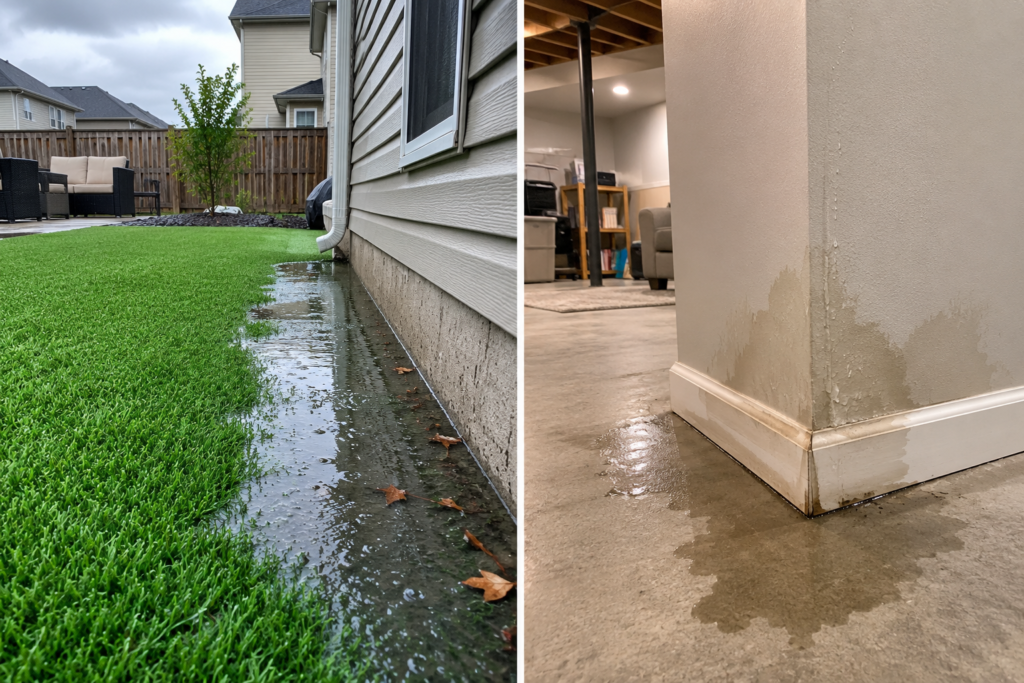
You saved up, did the research, and finally had artificial grass installed in your backyard. No more mowing. No more muddy paw prints. No more dead patches after a dry summer.
Then the next heavy rainstorm hit and water started appearing in your basement.
If this sounds familiar, you are not alone. This exact scenario has been reported by homeowners across the country, and the reason almost always comes back to the same set of installation mistakes. Artificial grass itself is not the problem. The way it was installed specifically how drainage was or wasn’t planned underneath it is almost always the culprit.
This post explains exactly why it happens, what signs to watch for, and what steps to take if water has already made it inside your home.
How Artificial Grass Is Supposed to Handle Rain
Before getting into what goes wrong, it helps to understand how a properly installed artificial turf system is designed to work.
Modern artificial grass has a perforated or fully permeable backing that allows rainwater to pass straight through the surface blades and into a compacted sub-base layer beneath. That sub-base typically made of crushed stone or decomposed granite absorbs the water and allows it to drain naturally into the surrounding soil.
When the system is designed correctly, it can drain water at impressive rates: some turf backings are rated to handle over 1,000 inches of rainfall per hour. Even during heavy Ohio storms, a properly installed turf system should manage runoff without sending a drop toward your foundation.
The problem is that “designed correctly” depends on several steps that are easy to skip and that many installers, particularly lower-cost ones, do skip.
The 4 Installation Mistakes That Lead to Basement Flooding
1. No French Drain Was Installed
A French drain is a gravel-filled trench with a perforated pipe running through it, installed around the perimeter of the turf area. Its job is to intercept water that drains through the turf and direct it safely away from the house.
When no French drain is included which is one of the most commonly reported installation shortcuts all that water has nowhere to go except wherever gravity takes it. If your house sits at a low point, or if the ground naturally slopes slightly toward your foundation, that water will follow that path every time it rains.
One homeowner on r/landscaping put it plainly after discovering this exact issue: “There was no French drain installed.” A fellow user added that the turf appeared to be sloping toward the house, and that the previous natural grass had been absorbing enough runoff to mask the problem for years. The artificial turf’s compacted sub-base eliminated that absorption and the flooding started immediately.
2. The Turf Was Graded With a Negative Slope
Proper turf installation requires the ground beneath to slope away from your home a drop of about 1 to 3 percent over the turf area. This is called a positive grade, and it is what ensures rainwater flows outward rather than inward.
A negative grade where the surface slopes even slightly toward your foundation turns your new turf into a funnel that concentrates every inch of rainfall and directs it straight at your basement wall.
Natural grass partially compensates for a mild negative grade because soil and root systems absorb some of that water before it reaches the foundation. Artificial turf has no such absorption. The compacted gravel sub-base actually accelerates runoff. If the slope is wrong, the damage will come fast and repeatedly.
According to guidance from the University of Illinois Extension on yard drainage, homes should maintain a minimum of six inches of drop over the first ten feet away from the foundation. Any landscaping project turf included that doesn’t preserve or improve this grade creates a water intrusion risk.
3. The Sub-Base Was Not Properly Compacted or Chose the Wrong Material
The sub-base under your artificial turf is what makes the entire drainage system work. If it is made of the wrong material, or if it was not compacted correctly during installation, two things can happen.
First, fine-grain materials like sand or regular soil, when compacted, essentially become impermeable. Water pools above them rather than draining through. Second, a sub-base that was not compacted uniformly can settle unevenly over time, creating low spots where water pools often directly against your foundation.
Clay-heavy soil, which is common throughout Ohio, compounds this problem significantly. Clay drains very slowly on its own. If an installer laid turf over Ohio clay without first removing it and replacing it with permeable drainage aggregate, the natural soil acts as a barrier and pushes groundwater laterally often straight into the nearest opening in your basement wall.
4. Drainage Was Not Tested Before and After Installation
A basic professional standard for artificial turf installation is running a hose test over the prepared sub-base before the turf is laid, then running it again after the turf is installed. This confirms water is draining properly at each stage and catches problems before they are buried under two inches of synthetic fibers.
Many installers particularly those competing on price skip this testing entirely. By the time the first real rainstorm reveals the problem, the turf is already in, and fixing the drainage means tearing up part or all of the installation to correct the sub-base or add drains.
Warning Signs Your Turf Drainage Is Sending Water the Wrong Way
Watch for these signals in the weeks and months after installation:
- Water pooling along the edge of the turf closest to your house after rain
- Damp soil that stays wet for more than 48 hours after a storm in the area between the turf and your foundation
- New moisture appearing on basement walls or floors that wasn’t there before the installation
- A musty or earthy smell developing in your basement
- Efflorescence white, chalky mineral deposits appearing on basement walls (a sign of water moving through concrete)
Any of these signals means water is already reaching your foundation. The longer it continues, the higher the risk of mold growth, drywall damage, and structural deterioration.
What to Do If Water Is Already in Your Basement
If you have noticed moisture in your basement after a turf installation, there are two separate problems to address and the order matters.
Step 1: Address the water that is already inside.
Water that has entered your basement, whether standing water or moisture absorbed into walls, drywall, flooring, or insulation, begins promoting mold growth within 24 to 48 hours according to EPA guidelines on mold prevention. This is not a situation where waiting to see what happens is a safe option.
Homeowners in Summit County and surrounding areas can contact Akron OH Water Damage, a local IICRC-certified water damage restoration team serving Akron and the greater Summit County area. Their technicians use thermal imaging cameras and moisture meters to locate hidden water behind walls and under floors damage that looks dry on the surface but is actively causing deterioration and creating mold conditions underneath. Professional extraction, structural drying, and antimicrobial treatment stops the clock on that damage before it becomes a far more expensive mold remediation problem.
Step 2: Fix the drainage problem at the source.
Once the interior damage is addressed, go back to your turf installer or hire a drainage specialist to evaluate the grade and sub-base. Depending on what was done wrong, the fix might involve:
- Installing a French drain along the perimeter of the turf
- Regrading the sub-base to create positive slope away from the house
- Replacing non-permeable sub-base material with proper crushed stone aggregate
- Adding catch basins at low points to intercept and redirect water
This fix is essential. If you restore your basement without correcting the drainage, the next rainstorm will undo the restoration work.
How to Prevent This If You Haven’t Installed Yet
If you are still in the planning stage or if you are considering replacing your current turf here is the checklist every quality installation should include:
Ask your installer these questions before signing a contract:
- Will you perform a hose test on the sub-base before laying the turf?
- What is the existing grade of my yard relative to my foundation, and how will you ensure positive drainage?
- Will a French drain be included, and if not, why not?
- What sub-base material are you using, and how thick will it be?
- Does my soil type require any special drainage measures?
Any installer who cannot answer these questions clearly, or who dismisses drainage planning as unnecessary, is a risk. The IICRC the Institute of Inspection, Cleaning and Restoration Certification notes through its S500 water damage standard that preventing water intrusion at the source is always far less costly than restoring damage after it occurs. That principle applies just as much to landscaping as it does to plumbing.
The Bottom Line
Artificial Grass Installation is a genuinely excellent landscaping option when it is installed correctly. The problem is that drainage planning is the most important part of any turf installation and it is also the part most commonly cut to save money or time.
If your basement started flooding after a turf installation, the cause is almost certainly a drainage failure in the installation, not bad luck or coincidence. The good news is that it is fixable both the installation error and any interior water damage that has already occurred.
Act on the interior water first. Every hour that moisture sits in your walls or floors increases the risk of mold and deepens the structural damage. Then correct the drainage so it never happens again.
Leave a Reply