
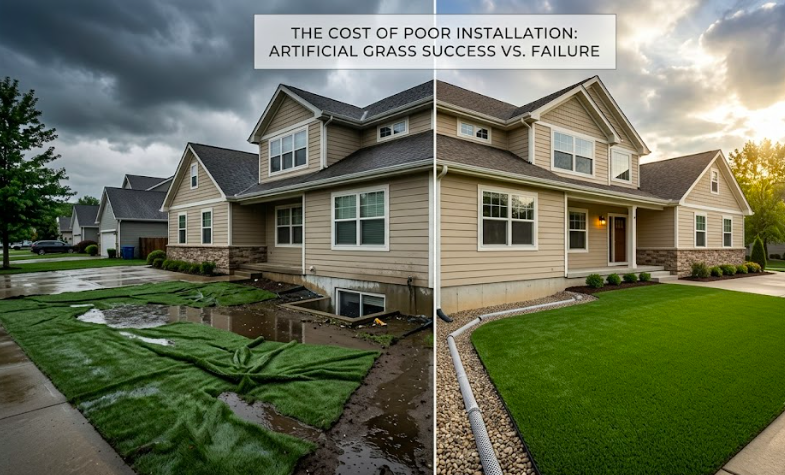
Artificial grass has become a go-to solution for homeowners who want a lush, low-maintenance lawn no mowing, no muddy patches, no watering bills. But here’s what most installation guides don’t tell you: a poorly drained artificial lawn can be one of the sneakiest causes of basement water damage.
At Heavenly Artificial Grass Installation, we’ve seen it happen more times than we’d like. Homeowners invest in a beautiful synthetic lawn only to discover weeks or months later that water is pooling near their foundation or slowly seeping into their basement. The culprit? Drainage mistakes made during or before installation.
This guide breaks down the most common artificial grass drainage errors and what you can do to prevent a small turf problem from turning into a major water damage disaster.
Why Artificial Grass and Water Damage Are More Connected Than You Think
Natural grass has deep root systems that absorb rainfall and allow moisture to percolate down through the soil. Artificial grass doesn’t. Instead, water must flow through the turf’s backing, through a sub-base layer, and then disperse away from your home.
When that drainage system isn’t designed correctly, rainwater has only one place to go: toward your home’s foundation.
According to the EPA’s guidelines on stormwater management, improper water flow near structures is a leading contributor to foundation damage and basement flooding across residential areas an issue that affects millions of American homeowners each year.
Mistake #1: Skipping or Skimping on the Sub-Base Layer
The most foundational (pun intended) drainage mistake is failing to install a proper sub-base beneath the artificial turf.
A correct sub-base typically consists of:
- 4–6 inches of crushed aggregate (like decomposed granite or Class II road base)
- A weed barrier membrane to prevent root interference
- Proper grading away from the home at a minimum 2% slope
When installers cut corners using inadequate depth, cheap fill material, or skipping grading altogether rainwater sits just below the surface. Over time, it saturates the soil and creates hydrostatic pressure against your basement walls.
What to do: Always insist on a compacted, well-graded sub-base from a certified installer. Don’t let cost savings here become foundation repair costs later.
Mistake #2: Improper Grading and Slope Direction
Even if you have a solid sub-base, water will find the lowest point. If the ground isn’t graded away from your foundation, that lowest point is your basement.
Many DIY installations and even some budget contractors fail to properly assess the natural grade of your yard before laying turf. They install the grass flat or worse in a way that slightly pitches water toward the house.
The golden rule: The ground beneath artificial turf should slope at least 1–2% away from any structures. For most homes, this means water should drain toward the street, a designated drainage basin, or a permeable area.
The International Association of Certified Home Inspectors (InterNACHI) recommends that all landscaping elements, hardscaping, and lawn installations be evaluated for proper water direction before any permanent work is done a standard that directly applies to artificial turf projects.
Mistake #3: Blocking Existing Drainage Channels
Yards often have hidden drainage infrastructure: French drains, dry creek beds, surface drains, and natural runoff paths. When artificial turf is installed without surveying these systems, the turf base or edging can inadvertently block or redirect existing drainage.
This is especially common when:
- Turf is installed directly against the home’s foundation edge
- Landscape edging is placed across a natural runoff path
- Infill material compacts over existing drain grates
Once blocked, water backs up. And backed-up water near a home finds its way through window wells, cracks in the foundation, or porous concrete directly into your basement.
What to do: Have your yard’s drainage mapped before installation. Ensure all existing drainage infrastructure is integrated into not covered by your new turf layout.
Mistake #4: Using Non-Perforated Turf Backing
Not all artificial grass products are created equal. Some lower-cost turf options use non-perforated or minimally perforated backing, which dramatically slows water drainage through the grass itself.
While premium turf products typically drain 30+ inches of rainfall per hour (more than enough for any storm), discount backing materials can drain as little as 10–15 inches per hour and when installed over an inadequate sub-base, standing water is almost inevitable.
Standing water creates two serious problems:
- Pooling near the foundation, leading to eventual water intrusion
- Moisture retention under the turf, encouraging mold, odors, and deterioration
Always verify drainage specs with your manufacturer before purchasing.
Mistake #5: Neglecting Perimeter Drainage Planning
The edges of your artificial lawn are where water problems most often originate. Without perimeter drainage solutions such as channel drains, French drains, or gravel borders water that flows off the turf surface has nowhere controlled to go.
In sloped yards, this creates concentrated runoff that can erode soil near your foundation and eventually work its way inside. In flat yards, it leads to pooling right at the base of your home.
Best practice: Install a perimeter drainage channel along any side of the turf that abuts your home, driveway, or patio. This directs water to a safe discharge point rather than letting it pool.
When Mistakes Happen: What Basement Water Damage Looks Like
Even with the best intentions, drainage failures happen. If you’ve recently had artificial grass installed and notice any of the following, it’s time to act fast:
- Water stains or efflorescence on basement walls
- A musty or mildew smell in your lower level
- Visible moisture, puddles, or damp carpet in the basement
- Cracks forming in foundation walls
- Peeling paint or bubbling drywall near basement windows
These are not “wait and see” symptoms. Water damage spreads quickly, and mold can begin growing within 24–48 hours of moisture exposure.
If you’re in the Akron, Ohio area and you’ve experienced any of these warning signs, we strongly recommend contacting a professional water damage restoration team immediately. The experts at Akron OH Water Damage specialize in residential water damage restoration and can assess whether your basement has been compromised before the problem gets worse. Fast, professional intervention can mean the difference between a simple dry-out and a full foundation remediation.
How to Protect Your Home Going Forward
Whether you’re planning a new artificial turf installation or suspect your existing one has drainage issues, here’s a simple protection checklist:
Before installation:
- ✔ Have your yard professionally graded
- ✔ Map all existing drainage infrastructure
- ✔ Verify turf drainage specs (aim for 30+ inches/hour)
- ✔ Plan perimeter drainage channels
During installation:
- ✔ Ensure 4–6 inches of compacted, crushed aggregate sub-base
- ✔ Confirm minimum 2% slope away from the home
- ✔ Integrate don’t block existing drains
After installation:
- ✔ Inspect your basement after the first heavy rain
- ✔ Check for standing water at turf edges
- ✔ Monitor for any musty odors indoors
- ✔ Recheck slope and drainage annually
Work With Installers Who Understand Drainage
At Heavenly Artificial Grass Installation, every project begins with a thorough site assessment including drainage evaluation before a single roll of turf is laid. We believe beautiful artificial grass and a dry, protected home aren’t competing goals. They go hand in hand, as long as installation is done right.
Don’t let a dream lawn become a drainage nightmare. Contact us today for a free consultation and site evaluation.
Leave a Reply