
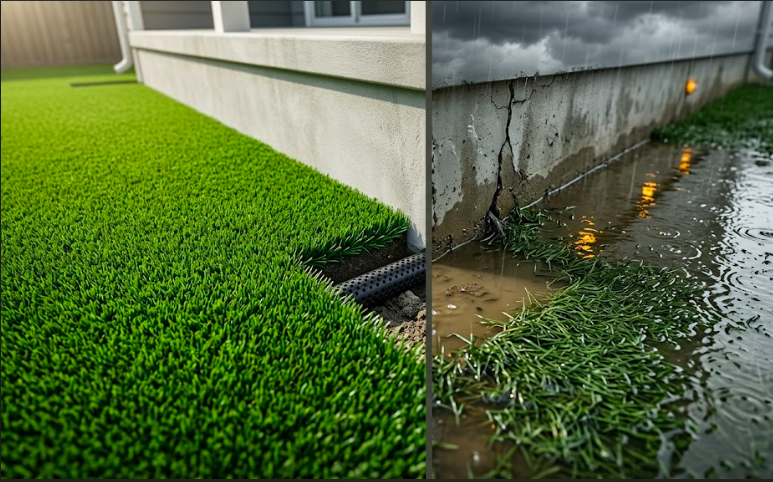
Artificial grass is one of the smartest investments an Ohio homeowner can make. No mowing, no muddy paw prints, no dead patches from summer heat. But there’s a detail that too many installers rush past one that can turn your gorgeous synthetic lawn into the source of a $20,000 water damage claim.
It comes down to where the water goes.
Natural grass has millions of root channels that pull rainwater downward. Artificial turf has none. Every inch of rainfall that lands on your synthetic lawn has to go somewhere and if your installer didn’t engineer that path, it will find its own, usually through your foundation, under your patio slab, or into your crawl space.
Real Risk, Real Costs
Water damage to a home’s structure is the second most common homeowners insurance claim in the United States. Poor drainage from hardscaping and synthetic surfaces is a growing contributor and one that’s almost entirely preventable with proper installation.
How Artificial Grass Can Trap and Redirect Water
Unlike soil, artificial turf is a low-permeability surface. High-quality artificial grass products come with perforated backing that allows water to pass through but that’s only half the equation. The critical question is: where does the water go once it passes through the backing?
Here’s what typically happens with a poorly planned installation:
- Inadequate sub-base grading – The crushed aggregate base beneath the turf is laid flat or slightly crowned the wrong direction. Water pools beneath the turf and saturates the surrounding soil.
- No perimeter edging with drainage channels – Water that exits through the turf backing has nowhere to flow. It creeps toward the path of least resistance often a gap between your turf and foundation wall.
- Compacted clay-heavy soil – Northeast Ohio has significant clay content in its soil. Clay doesn’t absorb water; it holds it. Without proper drainage infrastructure, water simply sits.
- Incorrect slope toward the house – This is the most catastrophic mistake. A grade that pitches even 1–2% toward a foundation will funnel rain directly into the structure with every storm.
The French Drain: The Component Most Homeowners Skip
A French drain is a gravel-filled trench containing a perforated pipe that redirects surface water and groundwater away from a specific area. When combined with artificial grass, it is often the single most important element of a safe installation and the one most frequently omitted to cut costs.
According to This Old House’s drainage installation guide, a correctly installed French drain can intercept thousands of gallons of water per storm event and route it safely to a storm sewer, dry well, or daylight outlet far from your home’s foundation.
When you skip the French drain beneath or around your artificial grass installation:
- Rainwater percolates through the turf backing and has no engineered outlet.
- Sub-base aggregate becomes saturated and begins to shift, causing turf rippling and seam failure.
- Hydrostatic pressure builds against foundation walls, leading to cracks, moisture intrusion, and mold.
- In freeze-thaw climates like Akron, Ohio, saturated soil that freezes expands and can permanently heave pavers, concrete edges, and the turf surface itself.
Ohio-Specific Note
Akron and the greater Summit County area receive an average of 38 inches of rainfall per year, plus 50+ inches of snowmelt. That’s enormous hydraulic stress on any landscaping surface. Proper sub-surface drainage is not optional here it’s an engineering requirement.
Warning Signs Your Artificial Grass Is Causing Water Damage
Water damage from poor turf drainage rarely announces itself dramatically. It creeps. Watch for these red flags:
- Standing water along the edges of your artificial grass after rain even hours later
- A musty or mildew smell near the turf, especially after warm wet weather
- Soft or spongy ground beneath the turf surface when walking on it
- Water stains on interior basement walls closest to the artificial grass area
- Efflorescence (white chalky deposits) on your foundation blocks or poured concrete
- Turf seams lifting, bubbling, or rippling where they were once flat
- New cracks or widening of existing cracks in your driveway, walkway, or patio adjacent to the turf
- Increased humidity inside your home, particularly on lower levels
If you’re noticing one or more of these signs, don’t wait. The window between “water intrusion” and “structural water damage” closes faster than most homeowners expect.
Already Seeing Water Damage Near Your Artificial Grass?
If moisture has already entered your home, you need professional remediation not just a drainage fix. The team at Akron OH Water Damage specializes in rapid assessment and restoration for exactly this scenario.Visit Akron OH Water Damage →
What a Properly Drained Artificial Grass Installation Looks Like
A professional installation that takes drainage seriously follows a specific sequence. The surface you see the beautiful, even turf is only the top layer of a carefully engineered system.
Step 1: Site Assessment and Grading
Before a single blade of grass is rolled out, the installation team should assess the existing grade and soil composition. In most Ohio residential applications, the grade should slope away from the house at a minimum of 1% (1 inch per 10 feet). If existing grade doesn’t cooperate, soil must be cut and recompacted before proceeding.
Step 2: Sub-Base Excavation
The native soil is excavated to a depth of 3–4 inches. This removes organic material that retains moisture and creates a clean work surface for the drainage layer.
Step 3: Compacted Aggregate Base
A mixture of crushed decomposed granite or Class II road base aggregate (typically ¾-inch minus) is laid and compacted in lifts. This layer does two things: it provides structural support so the turf doesn’t compress or shift, and it acts as a fast-draining conduit for water to move downward and laterally toward any drainage outlet.
Step 4: French Drain or Perimeter Channel (when needed)
In areas that receive significant rainfall, that adjoin hardscaping, or that sit near foundation walls, a French drain or channel drain should be installed at the lowest perimeter edge of the turf. Perforated pipe wrapped in filter fabric collects water from the aggregate layer and routes it to a safe outlet.
Step 5: Weed Barrier, Turf Installation, and Infill
Only after drainage is confirmed does the turf itself go down. The weed barrier must be permeable a non-permeable barrier defeats the entire drainage system. Infill (typically silica sand or crumb rubber) is brushed in to provide weight and blade orientation.
Pro Tip from Our Installers
Always ask your contractor to walk you through their drainage plan before work starts. A reputable installer will have a clear answer. If they can’t explain where the water goes, consider it a red flag.
When the Damage Is Already Done: What Restoration Looks Like
Even with the best intentions, drainage failures happen from contractor errors, from extreme rain events, from ground settlement over time. When water intrudes into your home’s structure, the restoration process involves several stages.
The EPA’s guidance on mold and moisture in homes makes clear that any porous material that has been wet for more than 24–48 hours is at risk for mold colonization. This means swift action isn’t just recommended it’s essential for your family’s health.
Professional water damage restoration typically involves:
- Emergency water extraction – Industrial-grade pumps and wet vacuums remove standing water from basements, crawl spaces, and living areas.
- Moisture mapping – Thermal imaging and moisture meters identify exactly how far water has migrated into walls, floors, and structural framing often far beyond the visible wet area.
- Structural drying – High-capacity air movers and dehumidifiers run continuously until moisture readings return to acceptable levels, typically 3–5 days for significant intrusion events.
- Mold assessment and remediation – If mold growth has begun (often visible within 72 hours), licensed remediation is required before reconstruction.
- Structural repair – Damaged drywall, insulation, subfloor, and framing are removed and replaced by restoration contractors.
For Akron and Summit County homeowners dealing with foundation water intrusion connected to outdoor drainage problems, we always recommend Akron OH Water Damage – a locally rooted restoration team with expertise in exactly this type of scenario. They understand the intersection of outdoor hardscaping, Ohio’s weather patterns, and residential water damage in a way that generalist contractors simply don’t.
The Complete Homeowner Prevention Checklist
Whether you’re planning a new artificial grass installation or auditing an existing one, use this checklist to protect your home:
- Confirm your contractor has a written drainage plan before work begins
- Request a site grading assessment grade must slope away from the house
- Ask specifically about French drains or channel drains at low perimeter edges
- Verify the weed barrier is permeable (water must pass through, not pool under turf)
- Inspect the installation 24 hours after the first significant rain
- Check your basement or crawl space for moisture after heavy storms for the first full season
- Clear any gutter downspouts that discharge near artificial turf areas redirect them at least 6 feet away
- If you notice any warning signs, get a moisture inspection before the next storm season
The Artificial Grass Company’s drainage resource is also a useful reference for understanding industry drainage standards and what to expect from a quality installation.
The Bottom Line
Artificial grass is a genuinely excellent choice for Ohio homeowners tired of fighting with natural turf. But it demands the same engineering respect you’d give any hardscape. Water doesn’t disappear because you laid synthetic turf over the ground it simply needs a new path.
The difference between a beautiful, worry-free lawn and a flooded basement often comes down to a few hundred dollars’ worth of drainage infrastructure and a contractor who knows what they’re doing. At Heavenly Artificial Grass Installation, drainage planning is a non-negotiable part of every project not an upsell.
And if you’re reading this because water is already inside your home, don’t wait. Contact the water damage restoration specialists at Akron OH Water Damage today. Fast action is the single biggest factor in limiting damage, limiting mold risk, and limiting cost.
Leave a Reply